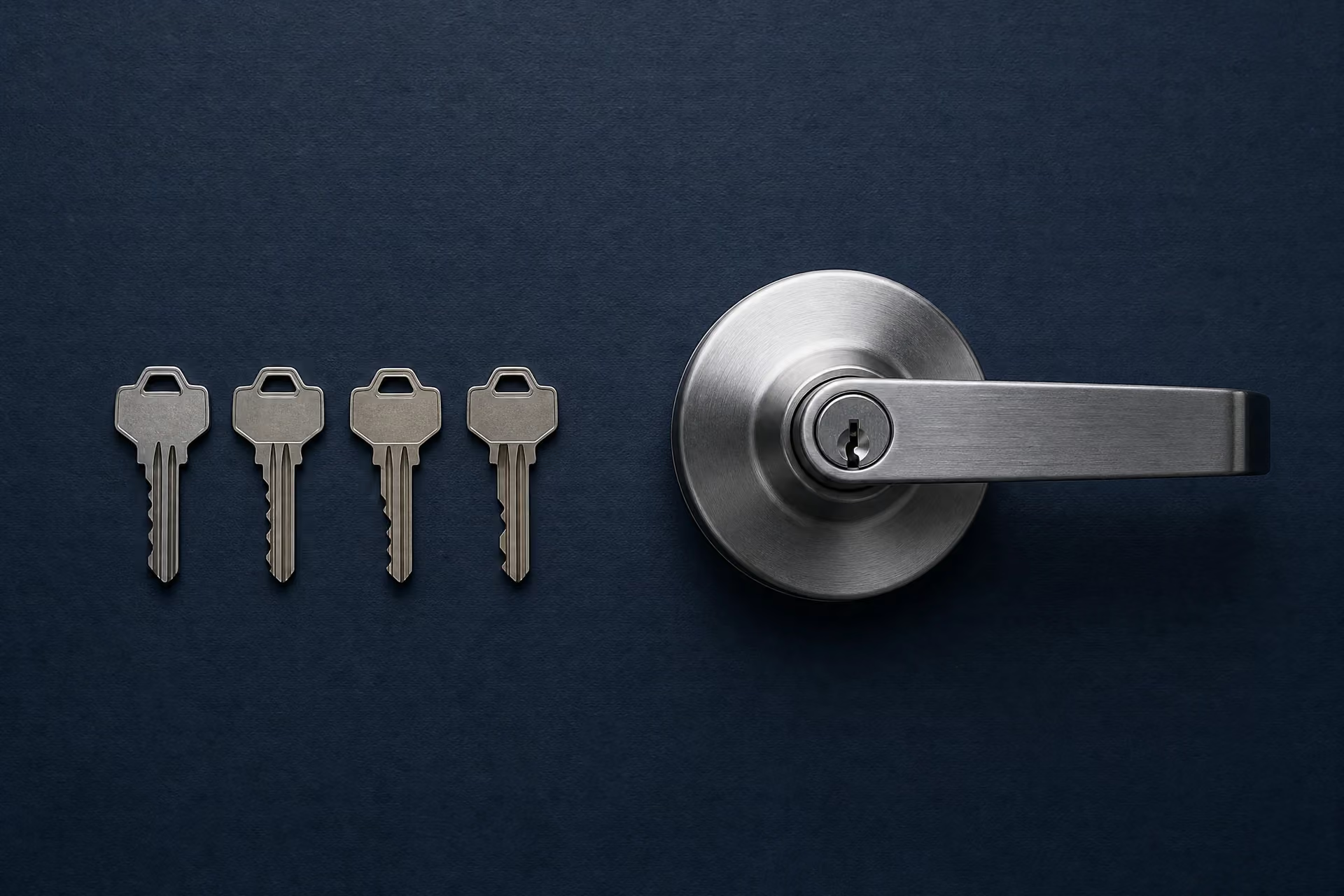
A master key system gives owners or managers broad access while limiting each employee’s key to the doors that person needs. For a business with multiple doors and more than one access level, the real advantage is controlled access and a clearer plan for employee turnover—not simply the convenience of carrying fewer keys.
How a master key system works
A standard pin-tumbler cylinder works when the cuts on one key align the pin stacks at the shear line. A master-keyed cylinder adds additional pin breaks so more than one approved key can operate it. This lets a business create a hierarchy of access without giving every employee every key.
- Grand master key: Access across multiple buildings or a wider property portfolio.
- Master key: Access across one building.
- Sub-master key: Access to a department, floor, or tenant suite.
- Change key: Access to one designated door or a limited set of doors.
When it makes sense for a small business
- One to three doors with identical access: Keying compatible locks alike is often simpler and more economical.
- Four or more doors with multiple access levels: A master key system can help separate owner, manager, employee, and contractor access.
- Multiple tenants or suites: Sub-master levels can keep tenant access separate while preserving building management access.
- High turnover or unreturned keys: Pairing the system with a restricted keyway strengthens control over copying.
- Frequent access changes or audit needs: Electronic access control may be the better primary solution.
What key control adds
A master key system organizes access, but it does not by itself stop a standard key from being copied. A restricted keyway limits blank distribution to authorized sources, allowing key issuance and approved copies to be tracked. That can reduce the need to rekey every opening when an employee leaves, provided the issued key is returned and the program is managed consistently.
What to prepare before a commercial walkthrough
- A door schedule: List every keyed opening, including exterior doors, offices, storage rooms, electrical and mechanical rooms, roof access, gates, and outbuildings.
- An access map: Map access by role rather than employee name—owner, manager, shift lead, cleaner, technician, and vendor.
- A growth plan: Tell the locksmith whether more suites, staff, or doors may be added so the hierarchy has room to expand.
- Master-key holders: Limit the highest-level keys to the few people who genuinely need them.
- Life-safety constraints: Fire-rated openings, exit devices, and egress doors require coordination with the relevant authority and hardware requirements.
When a master key system is the wrong answer
For a very small site with a single access level, a keyed-alike arrangement and written key log may be sufficient. If the real business need is an audit trail, instant credential revocation, or frequent schedule changes, electronic access control provides more visibility. If a frame, strike, or door itself is weak, repair the opening before investing in a more complex key system.
Use mechanical keys where simplicity matters and electronic credentials where accountability matters.
Frequently asked questions
Can existing locks be master keyed? Often, if the cylinders are compatible and in good condition. Mixed brands and worn hardware may require new cylinders or replacement hardware.
What happens if a master key is lost? A lost master key can require rekeying every opening it operated. Limit master-key holders and maintain a key-control record.
How is this different from access control? Keys are simple and do not need power, but they do not create an entry log. Fobs, cards, and codes can be revoked and logged, while requiring power and administration.
Next steps
Before selecting a provider, use our Texas locksmith verification checklist. For a hybrid approach, see smart-lock and access-management considerations. Explore commercial security services or schedule a commercial walkthrough with Precision Lock & Key.