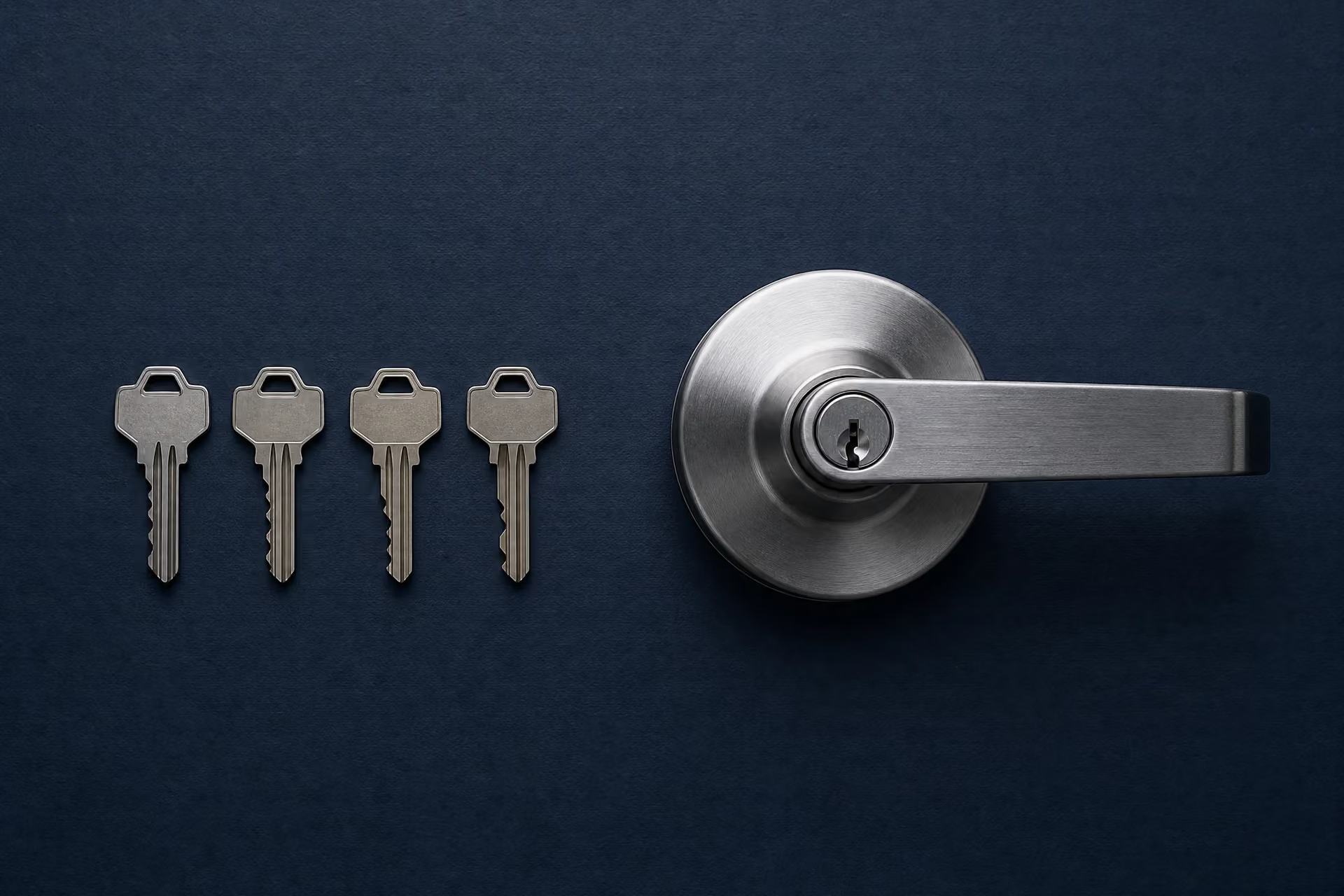
A master key system lets one key open many doors while each door still has its own individual key, which is what makes it useful. It is the right answer for most small commercial buildings until the day an employee leaves without returning a key, because at that point the whole system has to be rekeyed, not just one lock. Access control avoids that by making a credential revocable in software instead of physical. The cost of the two approaches crosses at a predictable point, and the deciding factor is usually turnover, not building size. We do this work across Spring, Houston and The Woodlands for shops, offices, medical suites, warehouses and multi tenant buildings. Here is the decision as it plays out, plus the code requirement that catches more small businesses than anything else on this page.
What is a master key system?
A master key system is a keying hierarchy. Each lock has its own change key that opens only that door. Above those sits a master key that opens a defined group, and above that, in larger systems, a grand master. In a small Houston office, the bookkeeper's key opens the front door and the bookkeeping office, a technician's key opens the front door and the shop, the manager's master opens the whole suite, and the owner's grand master covers the suite, the storage unit and a second location.
Nobody carries fifteen keys. Nobody has access they do not need. And access is documented on a keying schedule, which is a chart rather than a guess. That chart is the actual deliverable. A system designed on a napkin during the install is the one rebuilt in two years, because nobody left expansion room and the next door added forces a redesign.
The expensive surprise: one lost key, one whole system
Here is what small business owners consistently do not price in.
If an employee holding a change key leaves without returning it, you rekey that one lock. Annoying, cheap, done.
If an employee holding a master key leaves without returning it, that key opens every door in its group. Rekeying one lock accomplishes nothing, because the master still opens the rest. The correct response is rekeying every cylinder in that group and reissuing every key under it.
On a ten door suite that is a different order of expense, and it arrives with no warning on someone else's schedule. That dynamic is what pushes businesses with regular turnover toward access control, where revoking a departed employee takes fifteen seconds and costs nothing.
Two things reduce the exposure if you stay mechanical. Restricted keyways use patented or controlled blanks a hardware store cannot cut, so duplication requires supplier authorization. They do not stop someone keeping a key, but they stop the quiet copy you never learn about. Key control records, a signed log of who holds which key, issued when and returned when, cost nothing and tell you whether a departure requires one rekey or all of them.
When does access control make more sense?
Access control replaces or supplements keys with credentials: fobs, cards, PIN codes, mobile credentials. The lock is electrified, a controller decides who gets in, and the system keeps a timestamped log.
- Factor: Up front cost; Master key system: Lower; Electronic access control: Higher
- Factor: Cost to remove one person's access; Master key system: Rekey the affected group; Electronic access control: Delete a credential, no cost
- Factor: Employee turnover tolerance; Master key system: Poor above light turnover; Electronic access control: Designed for it
- Factor: Access log; Master key system: None; Electronic access control: Timestamped per door
- Factor: Schedule based access; Master key system: Not possible; Electronic access control: Yes, by person and by door
- Factor: Power dependency; Master key system: None; Electronic access control: Needs power, with battery backup
- Factor: After hours or contractor access; Master key system: Hand over a key; Electronic access control: Issue a time limited credential
- Factor: Adding a door later; Master key system: May force a redesign; Electronic access control: Add a reader
- Factor: Works during an outage; Master key system: Always; Electronic access control: Depends on backup and fail mode
The practical break point is turnover. A three person office where nobody has left in five years is well served by a properly designed master key system and restricted keys. A twelve person operation with seasonal staff, subcontractors and a cleaning crew will spend more on rekeys in two years than access control would have cost, and will still not know who opened the back door on a Sunday. A hybrid is common and often correct: access control on the main entry and any sensitive room, mechanical master keying on interior doors that do not turn over.
The exit door rule that gets small businesses written up
A master key is access control only until the key leaves the business.
This is the part worth reading even if you take nothing else from the page.
Houston enforces the 2021 International Building Code and the 2021 Houston Fire Code. Section 1010.2 states that egress doors shall be readily openable from the egress side without the use of a key or special knowledge or effort. Section 1010.2.1 adds that unlatching any door for egress shall require not more than one motion in a single linear or rotational direction to release all latching and all locking devices.
Read that second one carefully, because it is the one businesses trip over. A back door with a panic bar and a thumbturn deadbolt above it requires two motions. That is a violation even though both devices operate without a key, and it is extremely common in small retail and restaurant spaces where somebody added a deadbolt for peace of mind about the back alley. The other frequent one is a keyed deadbolt on an exit door, sometimes with the key hanging on a nail beside it. A key on a string is not compliance.
There is a limited allowance. Under 2021 IBC Section 1010.2.4, a key operated locking device is permitted on the main door in Group A buildings with 300 or fewer occupants, and in Groups B, F, M and S and places of worship, if conditions are met. Those include that the device is readily distinguishable as locked, that a durable sign with one inch letters reading THIS DOOR TO REMAIN UNLOCKED WHEN THIS SPACE IS OCCUPIED is posted, and that its use is revocable by the building official for due cause.
Note the scope. That covers the main door, not the back door, not the storeroom exit, and not the door your staff actually uses at close. And it is revocable, which makes it a permission rather than a right.
If you are worried about the back door, the answer is hardware built for the job: an exit device with an alarm, a delayed egress assembly where the occupancy permits it, or access control on the exterior face with free egress inside. The answer is not a deadbolt. Anything touching a fire rated door or delayed egress should be confirmed with the authority having jurisdiction before installation.
When you do not need any of this
Three doors and three employees who have been there for years does not need access control. Good cylinders, restricted keys and a written key log will serve you for a decade.
If your building is leased and the landlord controls the exterior doors, start with the lease. Many commercial leases specify who may alter door hardware and require the landlord's keyway on perimeter doors. That is a conversation you want before the invoice.
If your real problem is a door that does not latch, fix the door. We get called for access control quotes on buildings where the actual issue is a warped slab, a dragging closer or a misaligned strike that lets the door sit unlatched all afternoon. No credential secures a door that is not closing.
And if your concern is a former employee with a key, that is one call, not a project. Tell us what they had access to and we will tell you the smallest correct fix.
Frequently asked questions
What is the difference between a master key and a grand master key?A change key opens one door. A master key opens a defined group of doors. A grand master sits above multiple master groups, typically for an owner or across multiple locations. The structure is documented in a keying schedule that should be designed with room to add doors later.
Do I have to rekey everything when an employee leaves?It depends on what they held. A change key means rekeying that one lock. A master key means every cylinder in its group, because the master still opens the others. This is the main reason businesses with regular turnover move to access control.
Can a Houston business put a deadbolt on the back exit door?Generally no. Under the 2021 code, egress doors must be openable from the egress side without a key or special knowledge, and unlatching may require no more than one motion. A panic bar plus a separate deadbolt is two motions and is a common violation. Use hardware built for the purpose instead.
What is a restricted keyway?A keyway using patented or controlled blanks that ordinary hardware stores cannot cut. Duplication requires authorization from the supplier, so keys cannot be quietly copied. It does not prevent someone from keeping a key, so it works alongside a key log rather than replacing one.
Does access control still work in a power outage?It depends on the design. Systems are specified to fail secure or fail safe per door, and battery backup is standard on properly installed systems. Egress from the inside must remain free regardless of power state, which is a code requirement and not a configuration option.
Start with the keying schedule
Precision Lock & Key of Texas designs and installs master key systems, restricted key systems and access control for businesses across Spring, Houston and The Woodlands. We will walk the building, map who actually needs to go where, flag any egress hardware that will not pass, and give you a keying schedule you can hand to the next manager.
Call (346) 670-2818 or reach us through plktexas.com. Open daily 8 a.m. to 6 p.m., after hours emergency service available.
Precision. Security. Peace of Mind.
Code references are provided for general information. Confirm requirements for your specific occupancy, door and building with the authority having jurisdiction before making changes to egress hardware.
Related reading
Related services
Sources
2021 Houston Fire Code, Chapter 10: Means of Egress. Code references are general information; confirm requirements for a specific occupancy, door, and building with the authority having jurisdiction before changing egress hardware.